Page of Pentacles meaning at a glance
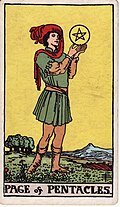
The Page of Pentacles holds one coin with absorbed attention while cultivated land stretches behind the figure. The central tension is between useful concentration and fixation: a promising skill, offer, course, or material goal needs patient study, but study can become delay if it never reaches practice. In a Rider-Waite-Smith (RWS) reading, the card may describe a beginner, a practical message, a teachable approach, or the first workable stage of a plan. It does not guarantee admission, employment, payment, profit, or any other event.
This guide explains the Page of Pentacles upright and reversed, including love, feelings, work, study, money, decisions, advice, actions, spread positions, timing, and yes-or-no limits. As a Page in the Pentacles suit, the card combines a learner's openness with questions about resources, skills, the body, work, time, and maintenance. Its most useful prompt is not "What reward is coming?" but "What can I learn, test, and build with the resources actually available?"
Rider-Waite-Smith imagery and symbolism
A youthful figure stands alone on green ground and lifts a large golden pentacle in both hands, gazing directly at it. The body is still and shown in profile, so the coin rather than the viewer receives the figure's attention. Green and warm-colored clothing connects the person visually with the fertile setting. Behind the Page are a grove of trees, a cultivated or furrowed field, a distant blue ridge, and an open yellow sky. There is no crowd, road traffic, or visible rush. The image concentrates the scene around one person, one object, and one sustained act of looking.
The pentacle is tangible and carefully held, supporting themes of resources, value, craft, study, and stewardship. The growing land suggests potential that requires conditions and labor rather than instant reward. The worked field adds an important distinction: curiosity becomes useful when it is practiced. The distant height can represent a longer aim, while the still posture keeps attention on the next learnable step. The bright sky makes the object easy to examine, but the Page has not yet shown what will be made from it.
Court rank matters as much as suit. A Page can represent a learner, messenger, early stage, role, or way of acting; it is not automatically a child, a particular gender, or a literal person. Compared with the Knight of Pentacles, who emphasizes repetition and delivery, the Page is still studying the object and forming a method. For a broader way to read rank without stereotyping people, use the tarot court-card guide.
Upright Page of Pentacles meaning
Upright, the Page of Pentacles can indicate practical curiosity, focused study, an apprenticeship, careful preparation, or a modest opportunity that deserves investigation. Its constructive expression joins attention with action. The reader might learn one skill, examine the terms of an offer, begin a realistic budget, make a first portfolio piece, or turn an abstract goal into a repeatable practice. The card favors willingness to be a beginner more than the appearance of already being accomplished.
- Constructive possibilities: disciplined learning
- useful feedback
- a grounded new plan
- an application or practical message
- careful use of time or money
- curiosity that produces a testable result.
- Difficult possibilities: perfectionism
- fascination with credentials or possessions
- preparing without starting
- treating one offer as the only option
- confusing potential with completed achievement.
- Questions to ask: What exactly am I learning? Which detail needs verification? What resource is available now? What is the smallest useful test? How will I know whether the practice is working?
An upright card is not an automatic promise of good news. The Page may show a worthwhile opening, but the course could be unsuitable, the job terms could be weak, or the budget could be incomplete. Concentration is a strength only when it remains connected to evidence, feedback, and an achievable next step.
Reversed Page of Pentacles meaning
Reversed, the Page of Pentacles does not automatically mean failure, laziness, or lost money. The upright theme may be blocked, internalized, excessive, delayed, or redirected. Blockage can look like unclear instructions, missing funds, weak support, or difficulty beginning. Internalization may be private study that is not yet ready to share. Excess may appear as perfectionism, status-seeking, hoarding information, or focusing on one detail until the larger purpose disappears. Delay may be wise when an offer or course still needs verification.
- If attention is scattered, choose one skill or task and define a short practice period.
- If preparation has become avoidance, produce a small draft, sample, application, or trial that can receive feedback.
- If resources are limited, reduce the scope and distinguish essential costs from attractive extras.
- If the goal no longer fits, redirect the same curiosity toward a more suitable course, role, or method.
- If self-criticism is blocking learning, assess the work against clear criteria rather than turning beginner status into a judgment of worth.
A reversed Page can also describe useful revision. Leaving a poor training program, declining unclear financial terms, or slowing down to correct a weak foundation may be responsible rather than negative. Choose a reversal method before the reading and keep it consistent; the upright and reversed tarot guide explains how blockage, internalization, excess, delay, and changed direction can work without turning reversed cards into bad omens.
Love, relationships, feelings, and actions
In love and relationship readings, the Page of Pentacles often emphasizes care that is still developing and is shown through concrete effort. Upright, it may support learning how another person communicates, keeping a modest promise, planning time together, or building trust through consistent actions. Attraction may be present, but the card gives more evidence for attention and willingness to learn than for dramatic passion or permanent commitment. Its difficult side is treating a relationship like a project to perfect or waiting for ideal conditions before speaking.
Reversed, the card may describe awkward effort, inconsistent follow-through, practical pressure, reluctance to risk imperfection, or an appealing connection that has not become workable. It can also indicate that someone needs more information before committing resources or time. If the question is "How do they feel?", the card cannot verify another person's private state. At most, it offers a hypothesis about the visible pattern: interest may be tentative, expressed practically, delayed, or mixed with concerns about capacity. Direct conversation and observable behavior matter more than the card.
- Love advice: replace a grand promise with one specific commitment that both people understand.
- Relationship challenge: notice whether learning each other's needs has become patient care or endless evaluation.
- Feelings prompt: separate your own interest from assumptions about what the other person will do.
- Possible action: ask a clear question, agree on a small plan, check whether effort is reciprocal, or revise an expectation that current time and resources cannot support.
Work, study, money, and decision-making
For work, the Page of Pentacles can highlight training, an entry-level responsibility, a new tool, a careful application, or a role that rewards attention to detail. Upright, it favors reading the brief, asking informed questions, practicing a core task, and building proof of skill. Reversed, it can point to procrastination, poor preparation, contradictory instructions, an impractical offer, or a learning plan too broad to sustain. It does not guarantee a job, promotion, qualification, or successful business.
In study, the Page is especially relevant to beginning a subject, improving technique, researching carefully, and accepting correction. The challenge is to turn notes into retrieval, exercises, drafts, or demonstrations. The Eight of Pentacles provides a useful comparison: the Page examines what may be learned, while the Eight shows repeated craft in progress. Neither card proves mastery.
For money, the card can prompt budgeting, comparison of fees, learning a financial concept, or checking the material requirements of a plan. It is not an investment signal and does not promise funds. In decision-making, the Page recommends identifying what can be learned cheaply before making a large commitment. Ask which option offers a sound learning path, what the real cost is, and what evidence would justify the next stage.
- Work: confirm the requirements, make one useful sample, and request feedback from the person who can evaluate it.
- Study: narrow the topic, schedule deliberate practice, and test recall or performance instead of only rereading.
- Money: compare current numbers and written terms
- do not treat optimism as financial evidence.
- Decision: favor a reversible trial when the long-term value is still uncertain.
- Advice: approach the issue as a learner while keeping standards and boundaries.
- Actions: research, practice, budget, apply, document, ask, test, revise, or decline unclear terms.
Page of Pentacles in spread positions
A spread position determines what the Page is doing. Define positions before drawing; the three-card tarot spread guide offers layouts that keep situation, challenge, advice, and outcome distinct. The card contributes a lens of learning, tangible resources, and early development rather than a fixed prediction.
- Situation: a practical beginning, learning curve, application, resource question, or undeveloped skill may be central.
- Challenge or obstacle: scattered focus, perfectionism, weak foundations, unclear costs, or fear of being inexperienced may slow progress.
- Advice: inspect the details, ask a basic question without embarrassment, and complete the smallest useful test.
- Action: enroll, practice, budget, draft, compare terms, or gather feedback, provided the step fits real circumstances.
- Outcome: a new stage of competence or a modest opening may develop if preparation becomes practice
- completion is not guaranteed.
- Past: an earlier lesson, offer, or resource decision still shapes the present issue.
- Present: concentrate on one concrete task and notice what the evidence teaches.
- Future: a possible learning opportunity may appear, but its timing and value depend on choices, conditions, and surrounding cards.
In a relationship spread, a self position can describe your willingness to learn and show care; an interaction position can describe how practical effort is exchanged; an other-person position should stay with observable conduct or the role represented, not claimed access to a private mind. In an opportunity-risk-advice spread, the Page can show a learnable opening, the risk of inexperience or overpreparation, and advice to verify before committing.
Timing and yes-or-no limitations
The Page of Pentacles cannot supply a reliable date. Its stillness and earth-related suit may feel gradual, while its Page rank suggests an early stage, but those associations do not calculate days, weeks, or months. If timing matters, identify the real dependency: an application deadline, payment schedule, study milestone, available budget, or reply from a named person. Reversed may suggest delay or redesign, but it cannot measure how long either will take.
For yes-or-no questions, an upright Page may be read as a conditional lean toward "yes, if you are willing to learn, verify the details, and start modestly." Reversed may lean toward "not yet; the foundation, focus, or resources need work." Neither orientation is a dependable verdict. A more useful question is: "What must I understand or test before I invest further?"
Practical reading scenario
Imagine someone considering an expensive professional course draws the Page of Pentacles in the advice position. A weak reading says enrollment is destined to bring money because the Page holds a coin. A stronger reading uses the card's focused gaze and cultivated setting to create a verification plan: compare the syllabus with the required skill, ask how student work is assessed, calculate the full cost, speak to a qualified person in the field, and try a small introductory project before paying. If the Page is reversed, the advice may be to narrow the goal or repair a prerequisite, not to declare the person's education doomed.
Common misreadings
- "The Page always means a child or student." A court card can represent a person, role, stage, message, or approach.
- "The coin guarantees money, a job, or a successful investment." It centers a resource theme
- real outcomes require evidence and action.
- "Upright means the offer is trustworthy." The Page recommends inspection and learning, not automatic acceptance.
- "Reversed means laziness or low intelligence." It can instead show limited resources, private study, poor fit, delay, perfectionism, or a needed change of method.
- "Slow progress means nothing is happening." The card distinguishes deliberate preparation from indefinite avoidance
- context determines which is present.
- "The Page knows what another person feels." Tarot cannot establish a third party's private thoughts.
- "The card provides an exact date or certain yes." Rank, suit, and imagery do not create reliable timing or binary certainty.
Useful card connections
The Ten of Pentacles precedes the Page in the suit sequence and can contrast an established family or resource system with a learner discovering how to participate in it. The Knight of Pentacles shows what changes when attention becomes routine and responsibility. The Eight of Pentacles emphasizes active repetition, helping a reader ask whether the Page has moved from admiration to practice. These connections clarify development without erasing the Page's distinctive single coin, attentive gaze, and open field.
Responsible use and next steps
Tarot can support cultural study, journaling, planning, and reflective conversation. It does not replace medical care, mental-health support, legal advice, financial planning, educational counseling, employment guidance, or safety services. Do not use the Page of Pentacles to diagnose a condition, guarantee income, choose an investment, decide another person's intentions, or make a high-stakes commitment without current evidence and qualified help. Keep interpretations conditional and leave room to change course.
- What am I ready to learn rather than pretend to know?
- Which resource or cost needs a direct check?
- What small piece of work could produce useful feedback?
- Where has preparation become protection from being evaluated?
- What evidence would tell me to continue, revise, or stop?
Continue with the complete tarot card meanings hub for the full RWS deck, the Pentacles suit guide for the sequence from Ace through King, or the Knight of Pentacles for the next court card. Use the tarot symbols guide when you want to separate visible details, traditional associations, contextual interpretation, and real-world evidence.