Ace of Swords meaning at a glance
The Ace of Swords centers on a productive tension: a sharp idea can cut through confusion, but the same certainty can become careless or cruel when it outruns evidence. In a Rider-Waite-Smith (RWS) reading, the card may point to a new question, candid conversation, intellectual breakthrough, decision, or boundary. It does not prove that a belief is true, reveal another person's private thoughts, or guarantee victory. This guide covers the card's upright and reversed meanings, imagery, love and work applications, spread positions, practical advice, and the limits of timing and yes-or-no readings.
As the Ace of the Swords suit, this card introduces the suit's concerns with thought, language, standards, conflict, and discernment. An Ace represents concentrated potential and a beginning, not a finished result. The useful question is therefore not only "What is becoming clear?" but also "How will I test and use that clarity responsibly?"
Rider-Waite-Smith imagery and symbolism
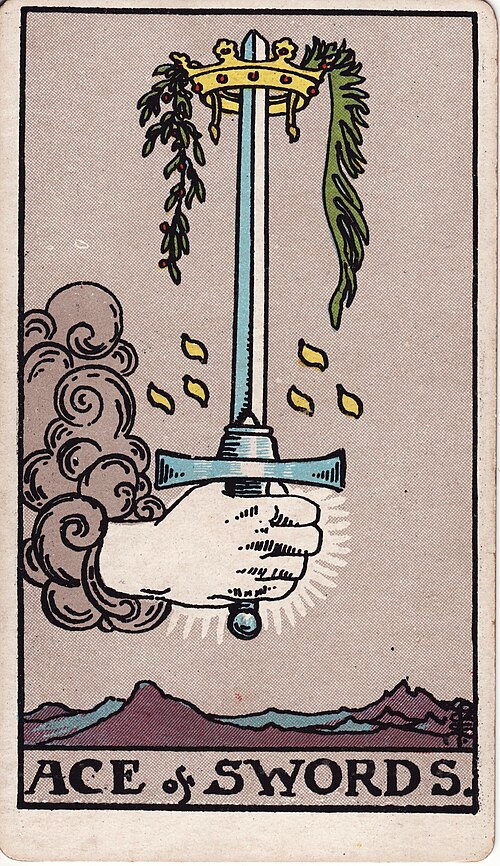
A hand emerges from a gray-white cloud and grips a double-edged sword upright. The vertical blade rises through a golden crown, with a palm frond on one side and an olive-like branch on the other. Small golden, flame-like marks appear around the blade. Far below, jagged blue-gray mountains cross the horizon beneath an open, pale sky. No complete person, room, road, or destination is shown. The eye is drawn from the firm hand upward to the blade and crown, while the difficult landscape remains distant.
The posture and direction create the card's main reading logic. The single upright sword suggests focus, definition, and a thought brought into view. Its two edges remind the reader that language and judgment can clarify or injure. The crown can support themes of mastery, consequence, and achievement, but it does not promise success. The palm and olive-like foliage can suggest endurance and peace, yet they hang from a weapon, so resolution still depends on how the tool is used. The mountains imply that a clean idea may face demanding conditions when applied. The hand's lack of a visible owner keeps the offer open: the card does not identify who will speak or act.
The Ace rank strengthens the sense of a starting point. One blade concentrates attention on a premise, distinction, or choice before the numbered Swords develop more complicated situations. This is an interpretation grounded in rank, suit, and image, not a scientific measure of intelligence or truth. For a method that keeps observation separate from inference, use the guide to reading tarot symbols without treating them as facts.
Upright Ace of Swords meaning
Upright, the Ace of Swords can describe fresh understanding, a well-formed question, direct communication, an important distinction, or a decision supported by relevant facts. Its constructive expression combines precision with accountability. It may help a reader name the actual problem, set fair criteria, ask for clarification, edit away distraction, or begin a conversation that has been postponed. The card can also represent the moment when an assumption becomes visible enough to examine.
- Constructive possibilities: clear thinking
- honest speech
- a research breakthrough
- useful feedback
- a principled boundary
- a new plan
- evidence that changes the question.
- Difficult possibilities: bluntness without care
- premature certainty
- intellectual pride
- cutting off options too soon
- treating an argument as proof
- using rules to dominate rather than clarify.
- Questions to ask: What do I know directly? What am I inferring? Which standard matters here? What evidence could change my view? How can I say the necessary thing without making harm the method?
An upright Ace is not always comfortable. Clarity may expose incompatible expectations, a flawed premise, or a boundary that needs to be stated. The card's benefit lies in greater definition, not automatic agreement. A responsible reading leaves room for correction and for the other people involved to answer in their own words.
Reversed Ace of Swords meaning
Reversed, the Ace of Swords does not automatically mean failure, deception, or a negative answer. The card's theme may be blocked, internalized, excessive, delayed, or redirected. Blockage can look like unclear instructions, missing evidence, or difficulty finding the right words. Internalization may be private analysis or self-criticism. Excess can appear as overthinking, a cutting tone, rigid certainty, or argument for its own sake. Delay may be appropriate when a decision depends on information that has not arrived.
- If clarity is blocked, define the smallest unanswered question and seek one reliable source or direct conversation.
- If the theme is internalized, draft the message privately before deciding whether it should be sent.
- If the sword is excessive, shorten the claim, soften the delivery, and listen for information that does not fit the first conclusion.
- If action is delayed, set a review date and state what evidence would justify moving forward.
- If the direction is wrong, reframe the question around your own choices rather than another person's hidden motives.
A reversal can also indicate useful revision: an old conclusion is being released, a harsh inner narrative is losing authority, or a complex issue needs more than a binary answer. Choose one reversal method before a reading and apply it consistently; the upright and reversed tarot guide explains several approaches without treating reversed cards as automatically bad.
Love, relationships, and feelings
In love or relationship readings, the Ace of Swords often directs attention to communication, definitions, consent, and boundaries. Upright, it may support an honest conversation, a clear request, a new understanding, or a decision about what kind of relationship both people are willing to build. Its difficult side is communication that values being right more than being understood. A new connection may benefit from explicit expectations rather than assumptions about exclusivity, pace, or commitment.
Reversed, the card can describe mixed messages, withheld words, defensive analysis, or a conversation that is poorly timed. It may also show someone privately sorting out what they can responsibly say. If the question is "How do they feel?", the Ace cannot verify a third party's inner state. At most, it offers a hypothesis about the communication pattern: feelings may be analyzed, named, questioned, or kept behind a need for certainty. Check what the person has actually said and done, and ask directly when consent and circumstances allow.
- Love advice: state one need without turning it into a verdict about the other person.
- Relationship challenge: distinguish a healthy boundary from punishment or abrupt withdrawal.
- Feelings prompt: name your own feeling before explaining it, defending it, or assigning it to someone else.
- Possible action: ask one clear question, agree on what a key term means, or pause a sharp reply until its purpose is clear.
Work, study, money, and decisions
For work, the Ace of Swords can highlight a new strategy, precise brief, contract term, candid review, or decision criterion. Upright, it favors making responsibilities, deadlines, and evidence visible. Reversed, it may point to vague instructions, scattered research, contradictory feedback, perfectionism, or a clever proposal that has not been tested. It does not guarantee a job offer, promotion, dispute outcome, or successful negotiation.
In study, the card suits thesis questions, close reading, editing, debate, exam planning, and learning how to distinguish a source from an interpretation. Its shadow is reducing a complex subject to one neat but unsupported answer. For money, the card can prompt careful comparison of records and terms, but it is not a market signal or promise of profit. For any consequential contract, financial decision, workplace dispute, or academic process, use current documents and qualified guidance.
- Work: rewrite the objective in one sentence, confirm who decides, and document the next step.
- Study: identify the claim, evidence, counterexample, and source you still need.
- Money: compare actual costs and terms rather than treating confidence as information.
- Decision-making: list criteria before choosing, then identify which assumption carries the most risk.
- Advice: communicate plainly, but keep the conclusion proportionate to the evidence.
- Actions: verify, edit, ask, define, document, negotiate, or wait for specified information.
Ace of Swords in spread positions
A spread position changes what the card is doing. In a three-card spread, define the positions before drawing rather than changing them to fit the card. The Ace supplies a lens on clarity, language, evidence, and choice; it does not turn every position into the same prediction.
- Situation: the issue may depend on a new fact, precise definition, candid exchange, or decision that can no longer remain vague.
- Challenge or obstacle: confusion, rigid certainty, an unspoken distinction, harsh delivery, or missing evidence may be blocking progress.
- Advice: ask the direct question, check the key claim, write the terms, or state a boundary you can uphold.
- Action: turn an idea into a draft, conversation, comparison, application, or documented next step.
- Outcome: greater clarity or a firm decision may become possible if the relevant evidence and communication are handled well
- this is conditional, not guaranteed victory.
- Past: an earlier insight, conversation, rule, or decision still shapes the present question.
- Present: define the issue now and separate observation from interpretation.
- Future: a possible realization or conversation may emerge, but timing and outcome depend on information, choices, and surrounding cards.
In a relationship spread, a self position asks how you use speech and boundaries; an interaction position describes the pattern created between people; an other-person position must stay with observable behavior or the role represented in the reading, not claimed access to private thoughts. In an opportunity-risk-advice spread, the Ace can be opportunity through learning, risk through premature certainty, and advice through evidence-based communication.
Timing and yes-or-no limitations
The Ace of Swords does not provide a reliable calendar date. Its Ace rank can symbolize a beginning, and its direct image can feel immediate, but neither feature establishes when an event will occur. If timing matters, set a real deadline, identify the information you are waiting for, and use the card to ask what would make the next step ready. Reversed may suggest delay or revision, but it cannot calculate how long either will take.
For yes-or-no questions, the upright card may be read as a conditional lean toward "yes, if the facts are clear and a decisive action is appropriate." Reversed may lean toward "not yet; clarify the premise or information first." Neither is a dependable binary verdict. A better question is: "What information, boundary, or decision would help me evaluate this choice?" The answer remains yours to test.
Practical reading scenario
Imagine a student receives conflicting feedback on a research proposal and draws the Ace of Swords in the advice position. A weak reading says the student is certain to succeed because the crowned sword guarantees victory. A stronger reading uses the image and position to suggest a method: rewrite the research question in one sentence, separate each comment into evidence and preference, identify the disagreement that most affects the method, and ask the supervisor one specific question. If the Ace is reversed, the advice may be to revise the premise before defending it, not to conclude that the degree will fail. The reviewable three-card case study shows how to record this kind of reasoning without rewriting it after the result.
Common misreadings
- "The Ace proves I am right." The card represents a clarity theme
- it does not validate a claim.
- "The crown guarantees victory." Achievement is one symbolic possibility, not an outcome contract.
- "A sword predicts violence, surgery, betrayal, or a breakup." Literal events require evidence
- the image more often organizes questions about thought, language, limits, and conflict.
- "Upright means I should say everything immediately." Honest speech still needs timing, consent, proportion, and care.
- "Reversed means stupidity, lies, or failure." It can instead indicate privacy, revision, delay, excess, or missing context.
- "The card gives an exact date or certain yes." It cannot supply reliable timing or remove the reader's responsibility for a decision.
Useful card connections
The Two of Swords shows what can follow when a new distinction meets an uncomfortable choice or incomplete information. The Five of Swords contrasts clear thinking with the costs of using argument mainly to win. The Ace of Cups offers a useful comparison between naming a truth and making room for feeling: together they can ask how honesty and emotional receptivity support one another. These connections add context without replacing the Ace of Swords' distinctive hand, blade, crown, and mountain imagery.
Responsible use and next steps
Tarot can support cultural learning, journaling, creative inquiry, and conversation. It does not replace medical care, mental-health support, legal advice, financial planning, employment guidance, or safety services. Do not use the Ace of Swords to diagnose a condition, determine guilt, justify surveillance, expose an absent person's supposed secret, or make a high-stakes decision without relevant evidence and qualified help. An upright card is not a guarantee, and a reversed card is not a punishment.
- What fact, assumption, and interpretation need to be separated?
- Which sentence would define the real decision without oversimplifying it?
- What evidence could change my conclusion?
- How can I make a boundary both clear and proportionate?
- What is the smallest responsible action I can take next?
Continue with the complete tarot card meanings hub for the full deck, the Swords suit guide for the sequence from Ace through King, or the Two of Swords for the next card. Use the tarot symbols guide when you want a repeatable way to separate what the image shows from what a reading claims.