Knight of Cups meaning at a glance
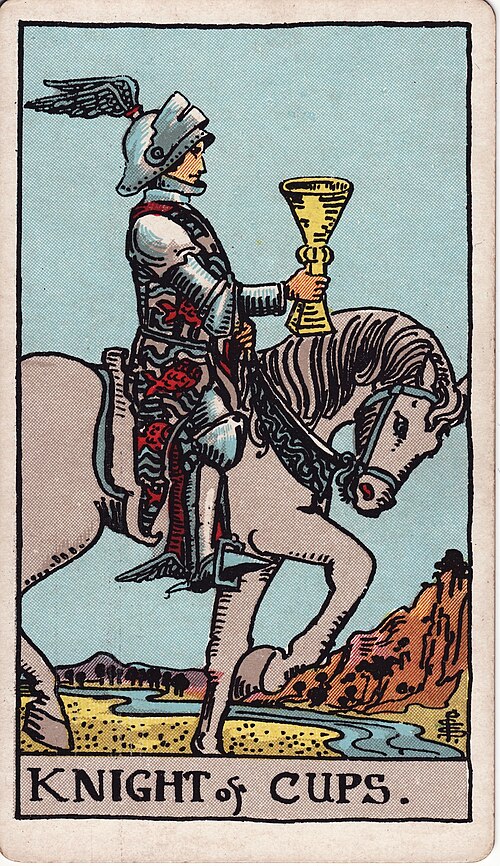
The Rider-Waite-Smith Knight of Cups carries a golden cup forward while his white horse moves at a controlled pace. That contrast is the card's central tension: a feeling, invitation, ideal, or creative vision is ready to travel, but an appealing gesture still needs consent, clarity, and follow-through. This guide explains the imagery, upright and reversed meanings, love and work applications, spread positions, practical advice, timing limits, and common misreadings.
As a Cups court card, the Knight combines emotional and imaginative themes with pursuit and movement. The Page notices or receives a feeling; the Knight tries to express or act on it; the Queen examines and contains it; and the King takes responsibility for how it is managed. Court rank is a reading tool, not a hierarchy of worth. The Knight can represent a person, a role, a method, or a phase of carrying inner values into an encounter.
Rider-Waite-Smith imagery and symbolism
In the familiar RWS image, an armored rider and white horse face toward the right side of the card. The Knight holds one cup upright and forward, as if presenting it without spilling it. The horse lifts a foreleg but does not charge. Rider and mount therefore show movement under restraint: there is an approach, yet the approach is measured rather than forceful. The cup is visible, suggesting an expressed feeling, proposal, apology, invitation, artistic offering, or stated value rather than something kept entirely private.
Blue fabric and red fish motifs connect the rider visually with the Cups suit, while winged details on the helmet and boots add imagination, aspiration, and mental movement. The bright armor introduces protection and formality: emotion is not simply overflowing but carried in a defined vessel. The white horse can support readings about an ideal, sincere intention, or a polished presentation, although color symbolism remains interpretive rather than factual.
A river crosses the dry landscape below distant hills or mountains. Water is present, but it follows a channel; the surrounding land is comparatively spare. This contrast reinforces the need to give emotion a workable route. The distant terrain also leaves room between intention and arrival. Taken together, the figure, cup, direction, color, posture, and landscape suggest an offer in motion whose quality will be tested by reality.
This page follows the illustrated RWS tradition. Other decks may change the rider's direction, landscape, clothing, or court structure, so their visual evidence may support a different emphasis. Start with what the card in front of you actually shows before applying general keywords.
Upright Knight of Cups meaning
Upright, the Knight of Cups can describe emotional expression becoming action. Constructive possibilities include a sincere invitation, diplomatic conversation, creative pitch, apology, proposal, values-led journey, or willingness to approach a delicate subject with care. The card's strength lies in making feeling communicable. It asks not only what you feel, but what you are prepared to offer and sustain.
- Constructive expressions: tact, emotional courage, creative momentum, romance with consent, a thoughtful message, mediation, and action aligned with stated values.
- Difficult expressions: idealization, charm without substance, an attractive story that avoids logistics, or a promise made before capacity is checked.
- Questions to ask: What exactly is being offered? Is it wanted? What action would make the message credible? Which practical condition could change the answer?
An upright card is not automatically easy or successful. The Knight may be sincere and still underprepared; the invitation may be clear and still be declined. A useful response is to match the scale of the gesture to the commitment you can keep. Put dates, costs, boundaries, responsibilities, and expectations into plain language when the situation needs more than atmosphere.
Love, relationships, and feelings
In a love or relationship reading, the Knight of Cups can highlight courtship, emotional initiative, an honest invitation, a wish to reconcile, or a more considerate way of speaking. It can also describe the querent's desire to be seen as caring or romantic. The card does not prove that another person is secretly in love, will return, or will accept a proposal. In an other-person position, read the observable role of invitation, pursuit, or emotional presentation rather than claiming access to private feelings.
As feelings, the Knight can suggest attraction, tenderness, longing, admiration, or a desire to move closer, but those are contextual possibilities rather than verified facts. Compare words with behavior. Ask whether communication is direct, whether both people can consent freely, and whether the relationship has enough practical support for the ideal being presented.
Work, study, creativity, and decisions
For work or study, the Knight may support pitching an idea, presenting creative work, applying for a values-aligned role, negotiating with tact, or finding a compelling way to communicate research. Inspiration needs delivery. Define the audience, scope, deadline, evidence, and next deliverable so that a polished concept can become usable work.
In decision-making, this card can favor an option that feels meaningful, relational, or creatively engaging. It cannot establish that the option is objectively best. As advice, make a clear and proportionate offer, invite a direct response, and remain willing to hear no. As an action card, it points toward a thoughtful message or concrete proposal rather than repeated private rehearsal.
Reversed Knight of Cups meaning
Reversed, the Knight of Cups can show the same themes blocked, turned inward, delayed, excessive, or redirected. A message may remain unsent, inspiration may lack a plan, or a beautiful offer may conceal vague terms. The reversal can also describe emotional pressure, escapism, disappointment with an ideal, inconsistent pursuit, or promises that exceed actual capacity.
- Blockage: fear of rejection, difficulty finding words, or no safe route for the offer.
- Internalization: imagining the conversation repeatedly without checking reality.
- Excess: melodrama, seduction, emotional pressure, or charm that outruns responsibility.
- Delay: a useful pause for consent and facts, or avoidance without a review date.
- Redirection: turning a fantasy into a smaller plan, setting a boundary, revising the offer, or withdrawing respectfully.
Reversed does not mean deception, bad character, or inevitable rejection. Sometimes the constructive reading is to slow down before speaking, protect a private creative process, or admit that an earlier dream no longer fits. Ask whether the pause is producing clearer terms. If not, choose one verifiable next step or close the loop rather than sustaining ambiguity.
How the Knight of Cups works in spread positions
- Situation: an invitation, emotional approach, creative proposal, or ideal is shaping the context
- check what has actually been offered.
- Challenge: idealization, indirect communication, fear of rejection, or weak follow-through may be obscuring the practical issue.
- Advice: express the feeling or value clearly, make a bounded offer, and leave room for the other person's response.
- Outcome: a possible phase of dialogue, pursuit, or creative movement
- the result still depends on consent, timing, resources, and subsequent choices.
- Past: an earlier proposal, dream, or style of pursuit may still influence the question.
- Present: attention is on how feeling is being translated into action now.
- Future: the card suggests a direction to prepare for, not a guaranteed visitor, message, romance, or event.
In a three-card situation, challenge, advice spread, the Knight changes function with each position. In situation, it may name the appealing proposal on the table. In challenge, it may expose assumptions hidden by persuasive language. In advice, it can recommend a tactful approach with specific terms. The same image supplies a vocabulary; the position supplies the grammar. The site's three-card tarot spreads guide offers more ways to define positions without treating the final card as fate.
Practical reading example
Imagine a designer asks, “How should I approach a potential collaborator about a small project?” The upright Knight of Cups appears in the advice position. A useful interpretation is not “They will say yes.” It is: present the idea warmly and directly, explain why the collaboration matters, and support the invitation with a one-page scope, budget range, deadline, and easy way to decline. The card contributes the quality of the approach; the written terms and the collaborator's response supply the evidence.
If the Knight were reversed, the same scenario might prompt the designer to check whether excitement has replaced planning, whether repeated messages are creating pressure, or whether the proposal should wait until the scope is clearer. The practical action could be revising the brief before contacting anyone, not abandoning the project or assuming rejection.
Timing and yes-or-no limitations
The horse's measured movement can be used metaphorically for a deliberate approach, but the image does not provide a reliable date, deadline, or speed. Surrounding cards, the spread's stated time horizon, and real-world schedules matter more than trying to convert the Knight into days or weeks. If timing affects travel, contracts, health, money, or safety, confirm it through ordinary sources.
For yes-or-no questions, the Knight of Cups is not a dependable binary answer. Upright may lean toward making or considering an offer; reversed may favor clarification, pause, or redirection. Neither orientation confirms acceptance or predicts a relationship. A better question is, “What would make this invitation clear, respectful, and workable?”
Common misreadings
- “A perfect lover is arriving.” The Knight may describe an approach or style, not a destined person.
- “They definitely have romantic feelings.” Tarot cannot verify a third party's private mind.
- “A proposal or wedding is guaranteed.” The cup supports invitation imagery, not a fixed event.
- “Reversed means liar or manipulator.” It may instead show fear, delay, privacy, excess, or poor planning.
- “This card gives an exact time.” The measured horse is symbolic and does not establish a date.
- “Charm proves sincerity.” A beautiful message still needs consent, consistency, and observable follow-through.
Court cards can represent people, roles, methods, or developmental stages, regardless of gender or age. The court cards guide expands that method, while the upright and reversed guide explains how to choose a consistent reversal lens instead of treating reversed cards as automatically negative.
Responsible use and reflection questions
Tarot can support cultural learning, self-reflection, creative practice, and preparation for a conversation. It does not replace medical or mental-health care, legal advice, financial planning, safety planning, direct communication, or informed consent. Do not use the Knight of Cups to diagnose someone, pressure a response, justify surveillance, or promise an outcome. For consequential decisions, combine reflection with qualified professional help and relevant evidence.
- What am I offering, and what evidence shows that it is wanted and workable?
- Where does my ideal help me act, and where does it excuse missing information?
- What promise can I keep before making a larger emotional or creative commitment?
- How would I communicate clearly while leaving the other person free to decline?
Continue learning
Compare the Knight's deliberate expression with the receptive curiosity of the Page of Cups and the discerning containment of the Queen of Cups. For suit and rank context, continue with the Cups suit guide and tarot court cards.
To strengthen reading method, use the tarot symbols guide to separate observation from interpretation, review upright and reversed meanings, or practice with three-card tarot spreads. Readers building a wider foundation can start with Tarot for Beginners.